

See how Peccin transformed their production scheduling
Learn how Peccin, a giant in the candy industry, reduced their scheduling time by 80% with Siemens Opcenter APS.

NEO is one of the largest Siemens Opcenter APS partners in the Americas.

Results achieved with Opcenter APS:
25%







90%



95%







50%

50%

50%
Test the solution right now with our Interactive Demo!
You will be redirected to our registration area to download the ebook.
Trusted by over 100 leading companies












Count on the market-leading APS software.

Finite Capacity
Opcenter takes the availability of material, machine and labor resources combined the real world constraints to give you an optimized, feasible production schedule.

Business Rules
Rely on a solution that incorporates specific business rules and constraints in a personalized way, to meet the needs of your operation.

Scenario Simulation
Simulate various scenarios to find solutions that minimize costs, lead times, inefficiencies, and inventory.

Agile Responsiveness
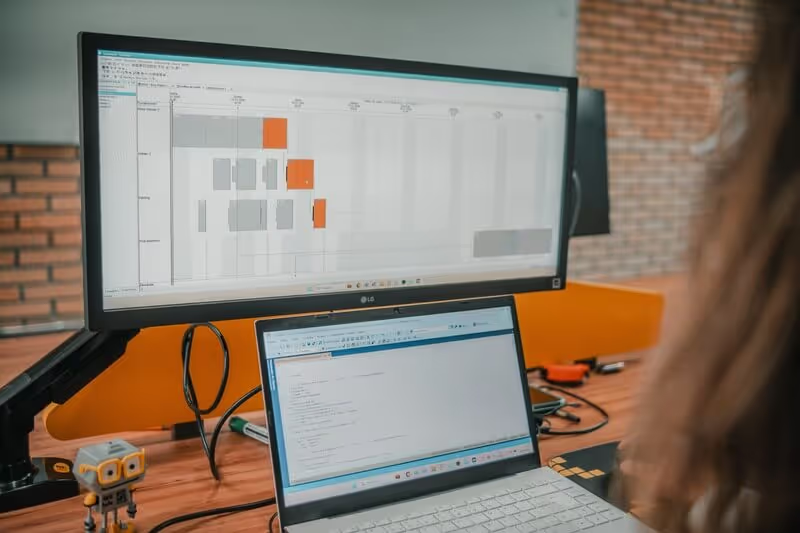
Flexible drag and drop scheduling so you can respond quickly to changes in demand or last minute orders.
Contact us to learn more about Opcenter APS
Optimize your company 's production planning and scheduling with the market-leading Opcenter APS system (formerly Preactor). Ensure production efficiency, reduce losses, and increase your service level.
Real Companies
Proven results.

Increase your
productivity
Generate production schedules using intelligent rules that minimize setup and wait times, reducing inefficiencies and enhancing productivity throughout your entire production chain.

Reduce
inventory
Through the application of smart rules, you can improve the synchronization of operations, reduce your work-in-progress inventory, and adopt a just-in-time model for raw material purchases, optimizing production and decreasing tied-up capital.

Satisfy your
customers
Gain full visibility. Explore various simulations with customized capacity and service priorities to reduce delays, while monitoring service levels over time and achieving higher customer satisfaction.

Increase
agility
Have the ability to respond quickly to commercial demands and production disruptions. Gain the ability to generate detailed and accurate scenarios, while analyzing the impact of changes across the entire supply chain in seconds.
Partner with a market leader operating in more than 10 countries.
Take the first step toward your digital transformation. Contact us now.
FAQS
Here are some frequently asked questions about Siemens Opcenter APS
What is Siemens Opcenter APS and what problem does it solve?
Opcenter APS is Siemens' advanced production planning and scheduling (APS) software, with the largest installed base in the world in this category—more than 6,500 company use the solution. It uses advanced algorithms to balance demand and capacity, generating feasible and realistic production schedules. The problem it solves is straightforward: eliminating the reliance on spreadsheets, guesswork, and manual replanning that cause delays, machine downtime, excess inventory, and missed delivery deadlines. Opcenter APS operates from long-term strategic planning (mes/years) to detailed shop floor sequencing, considering real constraints such as machine availability, labor, tools, and materials.
What is the difference between Opcenter APS and what my ERP already does in production planning?
Most ERP systems operate on the premise of infinite capacity and use backward scheduling. This means that the ERP calculates material requirements and dates, but cannot predict bottlenecks due to overload, nor understand how changes affect capacity and order deadlines. Opcenter APS works with finite capacity—it knows the real availability of each resource (machines, people, tools, materials) and generates a schedule that is actually executable on the factory floor. While the ERP answers "what to produce" and "how much," the APS answers "when," "on which resource," and "in what sequence," considering all constraints simultaneously.
We already have SAP — why would we need Opcenter APS as a complement?
SAP is excellent for order management, MRP, finance, and materials, but its capacity planning module wasn't designed for fine-grained sequencing with multiple constraints. Opcenter APS integrates directly with SAP (via IDocs, OData, SOAP, or Opcenter Connect) and acts as a complementary layer: SAP retains ownership of orders, inventory, and financial data (ISA-95 Level 4), while APS handles detailed sequencing and capacity optimization at the operational level (Level 3). The result is that SAP receives realistic schedules and more accurate confirmations, improving the reliability of the entire planning cycle.
Which ERP systems does Opcenter APS integrate with? (SAP, JDE, Oracle, Dynamics, etc.)
Opcenter APS is designed for integration with virtually any ERP system on the market. Established integrations exist with SAP (S/4HANA and ECC), Oracle, JD Edwards, Microsoft Dynamics, Infor, QAD, TOTVS, Epicor, and others. Integration can be done via native connectors, APIs, XML/CSV files, ODBC databases, or through Opcenter Connect (Siemens integration bus). In addition to ERPs, it also integrates with MESsystems, shop floor data collectors, demand forecasting tools, and OEE solutions. NEO Digital Industries conducts integration mapping as part of the implementation project, ensuring reliable data flow between systems.
What results can we realistically expect from an Opcenter APS implementation?
Results vary depending on the industry scenario, but the most frequent gains include: significant reduction in planning time (from days to hours or minutes), improved adherence to delivery deadlines (on-time delivery), reduction of work-in-process inventory (WIP), better utilization of machines and resources, decreased setup times, and proactive identification of bottlenecks. Company also frequently report greater agility in responding to changes in demand, urgent orders, and unforeseen events such as machine breakdowns or raw material delays. The return on investment tends to be rapid, generally perceived within the first mesof operation with the tool.
How long does an Opcenter APS implementation take, on average?
The implementation timeframe depends on the complexity of the operation, the number of resources to be modeled, and the level of integration with ERP and other systems. For smaller operations or a leaner initial scope, implementation can take from a few weeks to 2-3 mes. For more complex environments, with multiple plants, specific sequencing rules, and deep integrations, the timeframe can extend to 4-6 mesor more. The approach recommended by NEO Digital Industries is phased implementation—starting with a pilot scope (one product, line, or plant) and expanding progressively, allowing teams to absorb the tool at the right pace and ensuring ROI is realized from the start.
How does the implementation process work — what does NEO do and what do we do?
Implementation is a collaborative effort. NEO Digital Industries is responsible for the technical configuration of Opcenter APS, modeling of production resources and constraints, development of customized sequencing rules, integration with your ERP, and team training. On the client side, active participation from production planners and managers is expected to validate the production model, provide mesdata (routes, times, calendars, BOM), and test scenarios throughout the project. The process typically follows steps of requirements gathering, configuration and modeling, data integration, testing and validation with real-world scenarios, practical training, and go-live with follow-up. This partnership between NEO's expertise in the tool and the client's knowledge of their operation is what guarantees the project's success.
Does Opcenter APS work for manufacturing operations with multiple plants?
Yes. Opcenter APS supports multi-site planning, allowing company with multiple manufacturing units to optimize production in a synchronized manner across all plants. It's possible to visualize workload across different factories, balance demand between sites, and make decisions about where to allocate specific orders based on available capacity. The Opcenter Planning tool, in particular, is geared towards this level of tactical and strategic planning across multiple locations, while Opcenter Scheduling handles detailed sequencing at each plant individually. Furthermore, the browser-based companion product allows for centralized publication and viewing of scheduling statistics across all facilities.
Can Opcenter APS handle industry-specific constraints such as changeovers, allergen runs, or coil sequencing?
Yes, that's precisely one of Opcenter APS's greatest strengths. Unlike solutions that rely exclusively on generic algorithmic optimization, Opcenter APS is based on configurable heuristics (rules), allowing for the modeling of specific knowledge ("tribal knowledge") for each operation. This includes constraints such as sequence-dependent setup times (changeovers), cleaning rules between batches due to allergens or cross-contamination (very common in food and pharmaceuticals), coil sequencing by width or material, cleanroom rules, tool and operator qualification constraints, among many others. Customization is done during implementation, and new rules can be added over time without depending on the developer—the planner can adjust the system's behavior themselves.
Is Opcenter APS cloud-based or on-premise?
Opcenter APS offers deployment flexibility. Traditionally, it is installed on-premise as a high-performance desktop application. However, Siemens also offers cloud deployment options and hybrid models, including AWS infrastructure and integration with Teamcenter Share (Siemens' cloud collaboration solution). The on-premise version runs in a Windows Server environment, and Siemens has continuously invested in web-based functionalities to complement the desktop application. The choice between on-premise, cloud, or hybrid depends on each company 's IT infrastructure, security requirements, and digitalization strategy—NEO Digital Industries helps define the most suitable model for each scenario.
What is the difference between Opcenter APS and the old Preactor software?
In essence, they are the mesproduct. Preactor APS was a world leader in finite capacity planning and scheduling solutions for over two decades. In 2013, Siemens acquired Preactor and subsequently incorporated the solution into its Manufacturing Operations Management (MOM) portfolio, renaming it Opcenter APS. The name "Opcenter" reflects the integration within Siemens' broader scope of operations management, which also includes Execution (MES), Quality, Intelligence, and R&D solutions. Since the rebranding, several new versions have been released with improvements in usability, security, integration, and automation. Therefore, those familiar with Preactor can have complete confidence that Opcenter APS is the natural and improved evolution of the mestechnology, now with the backing and ecosystem of Siemens.